
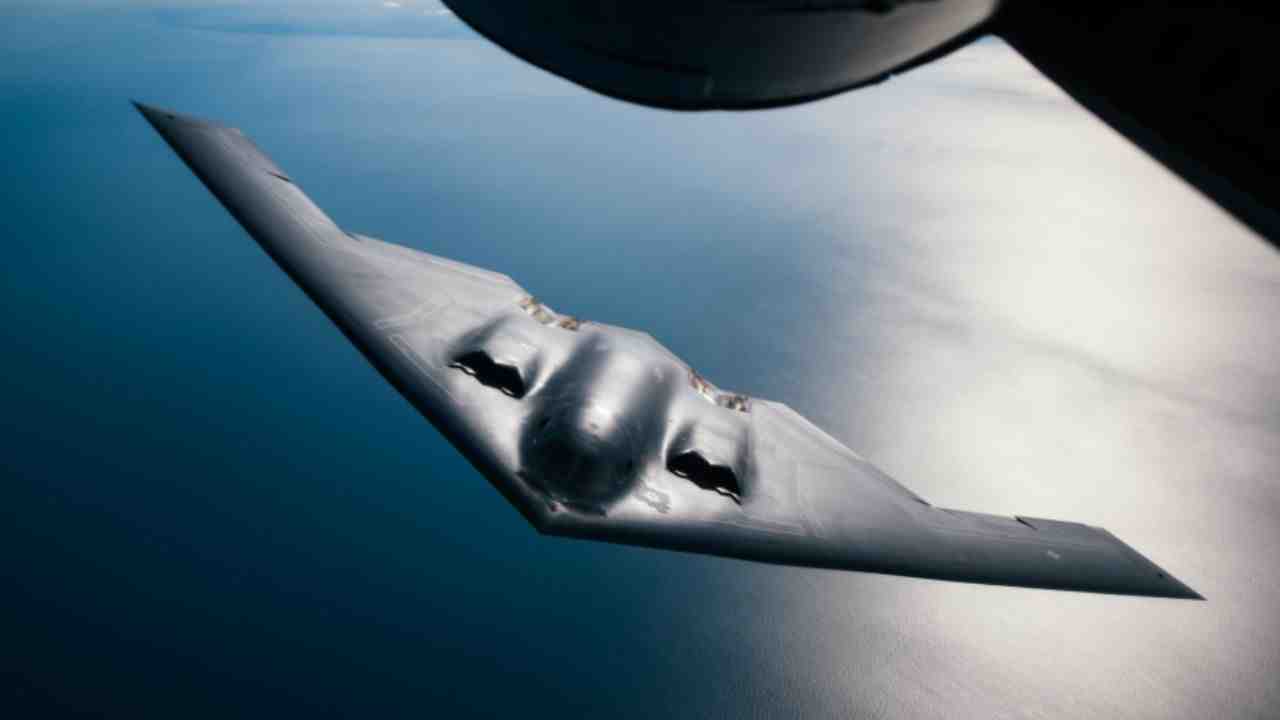
The stealth bomber B-2 Spirit was the protagonist of one of the longest and most complex missions in recent military aviation history.
The United States Air Force aircraft flew for 37 uninterrupted hours, departing from Whiteman Air Force Base in Missouri to reach its target: the Fordow nuclear enrichment facility in Iran. The round trip required multiple mid-air refuelings and the support of escort fighters and aircraft, in an operation carried out with minimal communication and absolute precision.
Designed to penetrate enemy air defenses undetected, the B-2 Spirit is one of the most advanced aircraft ever built. With stealth technology that reduces its radar signature to levels comparable to birds like sparrows, it can fly virtually invisible to conventional systems. This capability is enhanced by its flying wing design, lack of tail, and curved surfaces that deflect electromagnetic waves.
To endure such an extensive mission, the bombers feature comfort elements rarely found in combat aircraft. Pilots have access to a bathroom, microwave, and even a refrigerator to store food. There’s also enough space in the cockpit for one of them to rest while the other takes control. This is only possible thanks to the high automation of the aircraft, which is operated by a crew of just two members.
Each B-2 unit can carry up to 80 tons of payload, including powerful GBU-57 “bunker buster” bombs capable of penetrating dozens of meters of concrete before detonating.
With only 19 active units in the world and a cost of over $2 billion per aircraft, the B-2 remains a key piece of the US aerial strategy, with plans to stay operational until at least 2058.
The mission to Iran, carried out with six bombers, once again consolidated its role as one of the most sophisticated and lethal attack platforms ever created.
Source: New York Post / Quatro Rodas | Photo: X @usairforce | This content was created with the help of AI and reviewed by the editorial team
Dubbed “Operation Midnight Hammer,” @CENTCOM deployed multiple combined assets to inflict significant damage on three Iranian nuclear facilities.
More: https://t.co/adGPFvJsCH https://t.co/rm9aI4Qg3t
— U.S. Air Force (@usairforce) June 22, 2025
